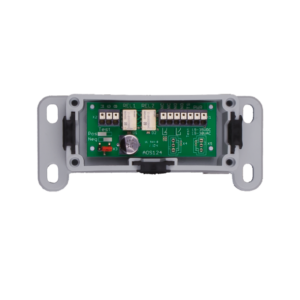
LOW POWER SIGNAL
Read more
Optics for sensor profile
Extremely low power consumption
Integrated diagnostic system with visual display
LED indicator for switching status
OSE output signal
IP 67, fully protected electronics
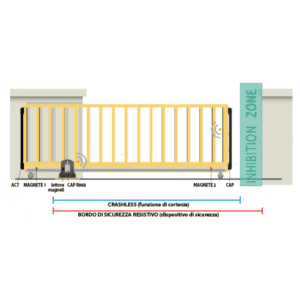
LOW-POWER-SIGNAL automatically selects the output frequency depending on the connected device: safety signals transmitted to a battery-powered radio link will therefore have a lower frequency than if they were sent directly to the control panel via a spiral cable.
This increases battery life and ensures compatibility with most control panels on the market.
Technical specifications
Power supply 3...27 VCC
Maximum door width 1...12 m
Output OSE signal
Warning lights Yellow LED indicator
Connections 3x0,14 mm²
Protection degree IP67, electronics encapsulated in epoxy resin
Data Sheet

SPK
Read more
Spiral cable
SPK spiral cables are made from high-quality materials, making them suitable for the most intensive installations. The extension factor is four times the block length (BL).
Spiral cables are resistant to microbes, hydrolysis and almost all mineral oils, thanks to a special sheath compound.
In addition, spiral cables are UV-stable and halogen-free.
The material is black PUR/PUR, the colour of the wires complies with DIN 47100:
3 wires = brown, white, green
4 wires = brown, white, green, yellow
5 wires = brown, white, green, yellow, grey
6 wires = brown, white, green, yellow, grey, pink
Variable cable ends (see table), including 40, 50, 60, 80, 100 or 200 mm without sheath and equipped with cable lugs (AEH).
Data sheet

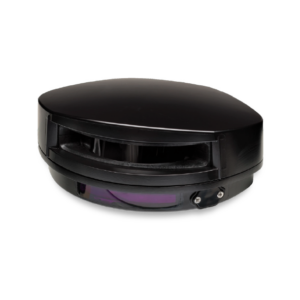
L36
Read more
Laser technology sensor for industrial gates and doors
L36 is an innovative photocell based on time-of-flight (ToF)
laser technology, designed for use on gates as a security device.
Compared to traditional photocells,
it does not require two devices or reflectors. L36 uses a laser rangefinder to measure the distance to an obstacle.
The photocell can be used in 3 different modes:
Mode A
OPERATION AS A PHOTOCELL
This mode requires a fixed physical reference point opposite the laser rangefinder. Maximum detection distance: 9 m.
The photocell analyses two events. Obstacle detection at shorter distance than the stored distance, during the learning phase.
Mode B
OPERATION AS A PROXIMITY SENSOR (APPROACH PERPENDICULAR TO THE LASER BEAM)
Maximum reading distance 6 m, optimised for detecting movements perpendicular to the beam.
The reading distance is programmable and can be adjusted in increments of 0.5 m during programming.
Mode C
OPERATION AS A SENSOR APPROACHING THE PHOTOCELL FROM ANY DIRECTION
Maximum reading distance 6 m, optimised for detecting movements approaching the photocell from any direction.
The reading distance is programmable and can be adjusted in increments of 0.5 m during programming.
Technical characteristics:
Power supply: 12-24V AC/DC
Transmission/reception angle: +/- 25°
Head rotation angle: 180°
Maximum range
Mode A: 9 m
Modes B and C: 6 m
Maximum output load: 30Vdc, 0.5A
Operating temperature: -10°C to +60°C
Protection class: IP54
Dimensions: 36x123x33 mm
Weight: 69 g
Data Sheet
Instruction Manual

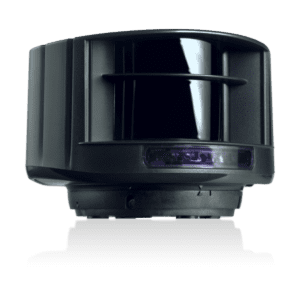
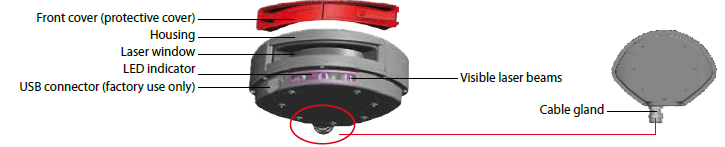
LZR-P110
Read more
Laser detector for automatic doors
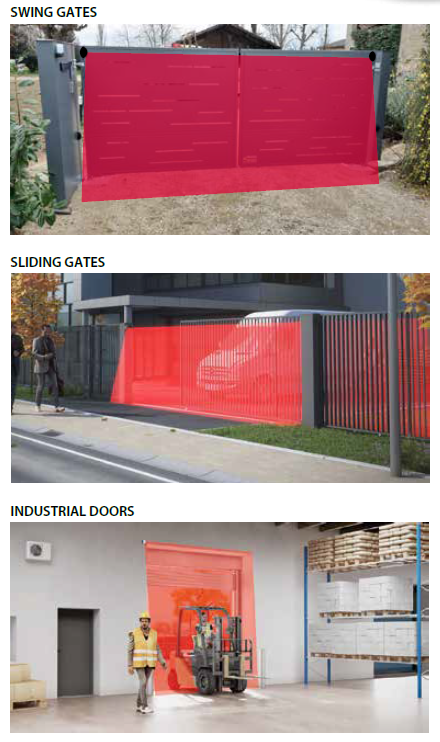
The LZR-P110 laser detector ensures the protection of sliding doors, swing doors and revolving doors in accordance with DIN 18650 and EN 16005 standards.
- Time-of-flight measurement: immune to ground reflectivity
- Free positioning of 2 virtual buttons for opening sliding doors
- Three-dimensional protection at the door threshold and near the closing area with 4 high-resolution laser curtains
- Integrated heating system and snow and rain protection filter (for outdoor use)
Technical features
Maximum detection distance: 5×5 m
Detection mode: presence
Power supply: 10–35 V DC via connector
Output: 2 congurable relays (e.g., slow speed and locking for revolving doors, virtual button and safety mode for sliding doors)
Protection rating: IP65
Operating temperature: -30°C to +60°C under power
Compliance: 2006/95/EC: LVD; 2002/95/EC: RoHS;
2004/108/EC: EMC; 2006/42/EC: MD; EN 12978:2009;
EN ISO 13849-1:2008 CAT2, Pl “d”; EN 60529:2001; IEC
60825-1:2007; EN 60950-1:2005; EN 61000-6-2:2005;
EN 61000-6-3:2006; IEC 61496-1:2009; EN
61496-3:2008 ESPE Type 2; EN 62061:2005 SIL 2; EN
16005:2012 Chapter 4.6.8; DIN 18650-1:2010
Chapter 5.7.4; BS 7036-1:1996 Chapter 8.1
Data Sheet
Instructions Manual